


Free CWAP-404 Exam Files Verified & Correct Answers Downloaded Instantly
Instant Download CWAP-404 Dumps Q&As Provide PDF&Test Engine
CWNP CWAP-404 Exam Syllabus Topics:
| Topic | Details |
|---|---|
| Topic 1 |
|
| Topic 2 |
|
| Topic 3 |
|
| Topic 4 |
|
| Topic 5 |
|
CWNP CWAP-404 Exam Certification Details:
| Exam Name | Wireless Analysis Professional |
| Exam Code | CWAP-404 CWAP |
| Passing Score | 70% |
| Sample Questions | CWNP CWAP-404 Sample Questions |
| Exam Registration | PEARSON VUE |
| Duration | 90 minutes |
| Recommended Training | CWAP self-paced training kit, Training Class |
| Number of Questions | 60 |
NEW QUESTION # 17
Given: Before installing a Wi-Fi network, ABC Company performed a spectrum analysis looking for problems. The 2.4 GHz RF spectrum looked like Image-A. After installing an ERP WLAN, ABC Company performed another spectrum analysis during business hours. The 2.4 GHz RF spectrum then looked like Image-B close to an AP on channel 1.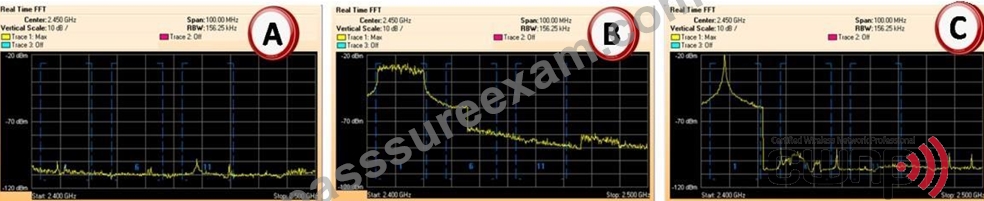
Now the 2.4 GHz RF spectrum looks like Image-C and access points and clients can no longer communicate on channel 1. What is happening on channel 1?
- A. The shape of the signals in images B and C indicates that a licensed user in this frequency range has enabled the "guard bands" in an effort to restrict local interference with other systems.
- B. Stronger transmissions from licensed 2.4 GHz users, such as HAM operators, are compressing the transmissions from the channel 1 access points into the lower portion of the band.
- C. Detection of a DFS radar event has discontinued 802.11 operation on channel 1, but the access point's Channel Switch Announcement frame cannot be sent due to the presence of radar.
- D. The access point's antenna connectors have been tampered with, causing "spike and shear" RF transmissions that are not compatible with the OFDM PHY format. For that reason, client devices cannot receive the AP's transmissions without error.
- E. A high-power, narrowband RF interference source on channel 1 is causing the CCA energydetects(ED) function on 802.11 devices to indicate a busy medium because the signal source is above the ED threshold.
Answer: E
NEW QUESTION # 18
Which statements regarding an IEEE 802.11 Channel Switch Announcement frame are true?
(Choose 2)
- A. Channel Switch Announcement frames are transmitted and retransmitted on a channel until all associated STAs successfully move to the new channel.
- B. Channel Switch Announcement elements may be carried in Beacon management frames.
- C. In an infrastructure BSS, Channel Switch Announcement frames may be transmitted by either the AP or an associated STA.
- D. Channel Switch Announcement frames are the only place where the Channel Switch Announcement element is found.
- E. Channel Switch Announcement frames use the Action frame body format.
Answer: B,E
NEW QUESTION # 19
The 802.11r-2008 amendment to the 802.11 specification introduces what new Information Elements (IEs) to facilitate fast BSS transitions? (Choose 2)
- A. DS IE (Distribution System)
- B. HT IE (High Throughput)
- C. RSN IE (Robust Security Network)
- D. MD IE (Mobility Domain)
- E. FT IE (Fast Transition)
- F. FSR IE (Fast Secure Roaming)
Answer: D,E
NEW QUESTION # 20
Which common feature of a Spectrum Analyzer would be the best to help you locate a non-802.11 interference source?
- A. Device finder
- B. Location filter
- C. Min hold
- D. Max hold
Answer: A
Explanation:
Explanation
The device finder is a common feature of a spectrum analyzer that helps locate a non-802.11 interference source. The device finder uses a directional antenna to measure the signal strength of a specific frequency or signal source. By pointing the antenna in different directions, the device finder can indicate the direction and distance of the interference source. The device finder can also filter out other signals that are not related to the interference source. The other options are not correct, as they do not help locate a non-802.11 interference source. Max hold and min hold are features that show the maximum and minimum RF power levels over time,respectively. Location filter is a feature that filters out signals that are not from a specific location or area. References: [Wireless Analysis Professional Study Guide CWAP-404], Chapter 3: Spectrum Analysis, page 77-78
NEW QUESTION # 21
Which one of the following is an advantage of using display filters that is not an advantage of capture-time filters?
- A. They only hide the packets from view and the filtered packets can be enabled for view later
- B. They allow for focused analysis on just the packets of interest
- C. Multiple of them can be applied simultaneously
- D. Once created they are reusable for later captures
Answer: A
Explanation:
Explanation
Display filters are applied after the capture is completed and they only hide the packets from view. The filtered packets are still present in the capture file and can be enabled for view later by changing or removing the display filter. This is an advantage over capture-time filters, which discard the packets that do not match the filter criteria and cannot be recovered later34 References:
CWAP-403 Study Guide, Chapter 2: Protocol Analysis, page 37
CWAP-403 Objectives, Section 2.3: Apply display filters
NEW QUESTION # 22
You are using a Wireless Aggregator utility to combine multiple packet captures.
One capture exists for each of channels 1, 6 and 11.
What kind of troubleshooting are you likely performing with such a tool?
- A. Interference source location.
- B. Fast secure roaming problems.
- C. Wireless adapter failure analysis.
- D. Narrowband DoS attack detection.
Answer: B
NEW QUESTION # 23
You want to simplify viewing frames of a particular type in Wireshark.
What is used to specify frames for colorization?
- A. A scripting language is available to modify the code before recompilation
- B. Filters are used to define the frames that should be colorized
- C. Automated protocol analysis is used and no additional options may be specified
- D. Custom code must be written and the binaries recompiled
Answer: B
NEW QUESTION # 24
You are repairing a misconfiguration in WMM settings on an AP.
The aCWmin and aCWmax values were all changed.
What is the default aCWmax for AC_BK?
- A. 0
- B. 1
- C. 2
- D. 3
Answer: C
NEW QUESTION # 25
Which one of the following is not an 802.11 Management frame?
- A. PS-Poll
- B. Beacon
- C. Action
- D. Authentication
Answer: A
Explanation:
A PS-Poll (Power Save Poll) frame is not an 802.11 management frame. A PS-Poll frame is a type of control frame that is used by a STA in power save mode to request data frames from an AP. A STA in power save mode can conserve battery power by periodically sleeping and waking up. When a STA sleeps, it cannot receive any data frames from the AP, so it informs the AP of its power save status by setting a bit in its MAC header. The AP then buffers any data frames destined for the sleeping STA until it wakes up. When a STA wakes up, it sends a PS-Poll frame to the AP, indicating its association ID and requesting any buffered data frames. The AP then responds with one or more data frames, followed by an ACK or BA frame from the STA. The other options are not correct, as they are types of 802.11 management frames. An Action frame is used to perform various management actions, such as spectrum management, QoS management, radio measurement, etc. A Beacon frame is used to advertise the presence and capabilities of an AP or BSS. An Authentication frame is used to establish or terminate an authentication relationship between a STA and an AP.
NEW QUESTION # 26
ABC International has installed a new smart ZigBee controlled lighting system. However, the network team is concerned that this new system will interfere with the existing WLAN and has asked you to investigate the impact of the two systems operating simultaneously in the 2.4 GHz band. When performing Spectrum Analysis, which question could you answer by looking at the FFT plot?
- A. Is the ZigBee system causing an increase in WLAN retries?
- B. Do the ZigBee channels used by the lighting system overlap with the WLAN channels?
- C. Is the ZigBee system using more than 50% of the available airtime?
- D. Is the WLAN corrupting ZigBee system messages?
Answer: B
Explanation:
Explanation
The FFT plot is a spectrum analysis plot that shows the RF power present at a particular frequency over a short period of time. It can help identify the sources and characteristics of RF signals in the spectrum. By looking at the FFT plot, you can determine which ZigBee channels are used by the lighting system and whether they overlap with the WLAN channels in the 2.4 GHz band. ZigBee channels are 5 MHz wide and WLAN channels are 20 MHz or 40 MHz wide, so there is a possibility of overlap and interference between them. The other questions cannot be answered by looking at the FFT plot alone, as they require other types of plots or analysis tools, such as duty cycle plot, airtime utilization plot, or protocol analyzer. References: [Wireless Analysis Professional Study Guide], Chapter 3: Spectrum Analysis, page 69-70
NEW QUESTION # 27
In the analyzer trace shown, the TBTT is nominally 102.5 milliseconds.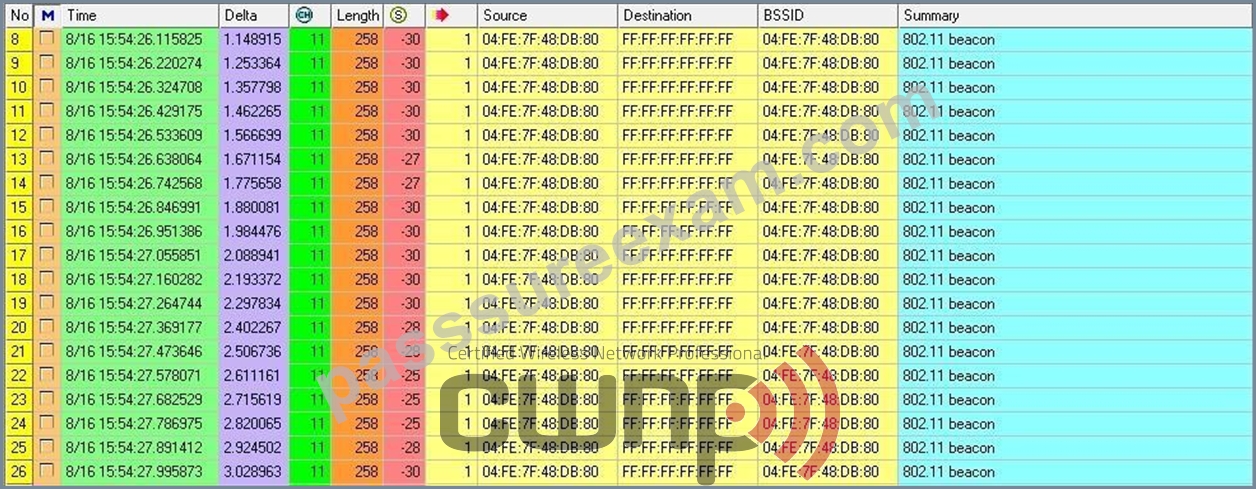
Why does the Beacon transmission interval vary?
- A. The access point must arbitrate to gain access to the RF medium in order to transmit a Beacon.
- B. Beacon frames vary in size, and therefore some take slightly longer to send than others.
- C. This trace shows an HT network where HR/DSSS nodes are active on the network. The access point is changing slot times from short to long as needed.
- D. The DCF Interframe space (DIFS) is nominally 50 ms, but typically varies by as much as 10 ms, which causes delays in Beacons.
Answer: A
NEW QUESTION # 28
The IEEE 802.11 Dynamic Frequency Selection (DFS) service is capable of performing what functions? (Choose 2)
- A. Requesting and reporting of measurements in the current and other channels
- B. Testing channels for radar before using a channel and while operating in a channel
- C. Using modulation switching techniques to avoid interfering with radar systems
- D. Suspending operations on a channel with high IEEE 802.11 co-channel interference
- E. Establishing an interference baseline on all 2.4 GHz channels
Answer: A,B
NEW QUESTION # 29
What MAC layer information will a dual-band 802.11n protocol analyzer capture if it is capturing data frames encrypted with WPA2-Enterprise? (Choose 2)
- A. Short Interframe Spaces
- B. Source IP Address
- C. Legacy Signal field
- D. Null Data frames
- E. Sequence Control fields
- F. TCP SYN datagram
Answer: D,E
NEW QUESTION # 30
Using a portable analyzer you perform a packet capture next to a client STA and you can see that the STA is associated to a BSS. You observe the STA sending packets to the AP and the AP sending packets to the STA. Less the 2% of all packets are retransmissions. You move to capture packets by the AP and, while the retry rate is still very low, you now only see unidirectional traffic from the AP to the client. How do you explain this behavior?
- A. The portable analyzer is too close to the AP causing CCI, blinding the AP to the client's packets
- B. There is a transmit power mismatch between the client and the AP and while the client can hear the Aps traffic, the AP cannot hear the client.
- C. The portable analyzer has a lower receive sensitivity than the AP and while it can't capture the packets from the client STA, the AP can receive them OK.
- D. The STA is transmitting data using more spatial streams than the potable analyzer can support
Answer: C
Explanation:
Receive sensitivity is the minimum signal level that a receiver can detect and decode. Different devices may have different receive sensitivity levels depending on their hardware specifications and antenna configurations. In this scenario, the portable analyzer has a lower receive sensitivity than the AP, meaning that it requires a stronger signal to capture the packets from the client STA.
The AP, on the other hand, has a higher receive sensitivity and can receive the packets from the client STA even if they have a weaker signal. This explains why the portable analyzer can only see unidirectional traffic from the AP to the client when capturing near the AP.
NEW QUESTION # 31
A PHY Header is added to the PSDU at which sub-layer?
- A. Network
- B. LLC
- C. MAC
- D. PHY
Answer: D
NEW QUESTION # 32
When a data frame is encrypted with WPA2, to which portion of the frame is the encryption applied?
- A. The whole MPDU
- B. Frame body including the LLCPDU
- C. Frame body and MAC Header
- D. Frame body excluding the LLCPDU
Answer: B
Explanation:
Explanation
When a data frame is encrypted with WPA2, the encryption is applied to the frame body including the LLCPDU. The LLCPDU (Logical Link Control Protocol Data Unit) is a part of the frame body that contains information such as protocol type, source and destination service access points (SAPs), and control fields. The LLCPDU is added by the LLC (Logical Link Control) sublayer to provide multiplexing and flow control functions for different upper layer protocols. When a data frame is encrypted with WPA2, which uses AES-CCMP as its encryption algorithm, both the payload and the LLCPDU are encrypted as a single unit. The MAC header and FCS are not encrypted, as they are needed for addressing and error detection purposes. References: [Wireless Analysis Professional Study Guide CWAP-404], Chapter 5: 802.11 MAC Sublayer, page 115-116
NEW QUESTION # 33
......
Exam Valid Dumps with Instant Download Free Updates: https://www.passsureexam.com/CWAP-404-pass4sure-exam-dumps.html
Fast Exam Updates CWAP-404 dumps with PDF Test Engine Practice: https://drive.google.com/open?id=1ew4XOMppCOAZph0IBog8GqnD949sJeHH